Why a tPA challenge test is clinically essential.
Is your ICU currently assessing fibrinolytic capacity in sepsis and DIC patients?
New research just published in Intensive Care Medicine confirms what functional fibrinolysis testing has been telling us — and why a tPA challenge test is clinically essential.

Tschirhart et al. (2026) demonstrate that sepsis-induced DIC is characterised by a marked depletion of functional plasminogen, driven by neutrophil elastase–NET complexes that fragment plasminogen into inactive forms. The result? Impaired plasmin generation, defective clot lysis, and a self-sustaining prothrombotic state that standard coagulation markers simply don't capture.
Critically, the study shows that plasminogen supplementation restored fibrinolytic capacity — both in septic patients and a murine DIC model — confirming that plasminogen depletion is a biologically defined, targetable mechanism in sepsis-induced coagulopathy.
So how do you detect this ?
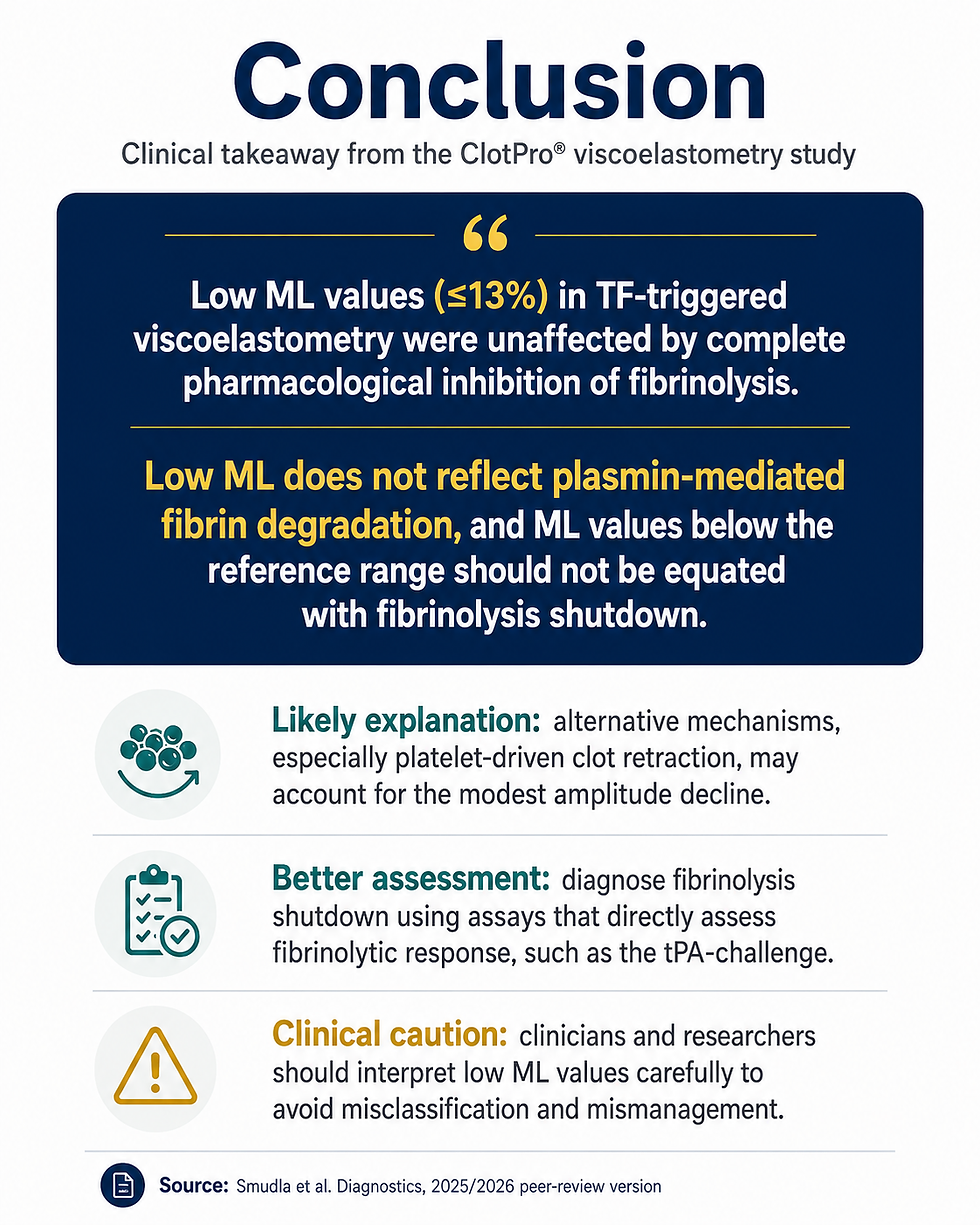
This is exactly where the Multiclot tPA assay delivers unique clinical value. By challenging whole blood with exogenous tissue plasminogen activator (tPA), the Multiclot tPA test provides a direct functional assessment of fibrinolytic capacity — revealing plasminogen depletion and fibrinolytic resistance that would be invisible on standard VET or routine coagulation screens.
As the authors note, future therapies targeting fibrinolytic restoration will require tools that can measure fibrinolytic function in real time. Multiclot's tPA test is already here.
📖 Tschirhart M et al. Plasminogen supplementation reverses fibrinolytic insufficiency in sepsis-induced disseminated intravascular coagulation: a pilot study. Intensive Care Med (2026). https://link.springer.com/article/10.1007/s00134-026-08338-0