
Clinical Resources
Practical summaries of emerging evidence in coagulation diagnostics, fibrinolysis, anticoagulation, and viscoelastic testing. Explore customer briefs, visual explainers, and publication-based insights designed for clinical, laboratory, and research use
For healthcare professionals in Australia. Educational use only.
Featured Clinical Briefs
Clinical Infographics
Visual summaries of the articles featured in our Clinical Briefs. Each infographic details the key findings, clinical context, and practical takeaways into a single reference designed for quick use at the bedside, in teaching, and in clinical discussions.
 Restoring Clot StabilityFibrinogen alone” is often not enough – FXIII depletion is real and clinically relevant. |  Grading Dynamic Fibrinolysis Resistance in SepsisA bedside grading system using TPA-LT/FIBA₁₀ that identifies three fibrinolysis endotypes in sepsis — associated with disease severity, organ failure and 28-day outcomes. |  HVD-ClotPro-FibrinolysisAt-a-glance summary "Is physiological lysis really plasmin-mediated fibrinolysis?" – reproduced from materials accompanying Smudla et al., Diagnostics 2026. |
|---|---|---|
 Personalised Thrombolysis for Acute PE in the ICUSingle-centre randomised feasibility trial of ClotPro-guided, individualised low-dose thrombolysis vs standard fixed-dose rtPA in high- and intermediate-high-risk pulmonary embolism. |  Therapeutic UFH — Critical Points in Monitoring & DosingNarrative review highlighting unresolved evidence gaps: aPTT vs anti-Xa limitations, uncertainty in the 0.3–0.7 IU/mL target, and why apparent heparin resistance often reflects complexity rather than true resistance. |  TXA & Fibrin StructureMechanistic study showing how the timing of tranexamic acid and the clot microenvironment shape its antifibrinolytic effect — including paradoxical acceleration of lysis in prophylactic models. |
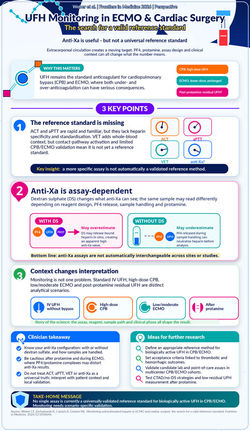 UFH Monitoring in ECMO & Cardiac Surgery — The Search for a Valid Reference StandardWhy anti-Xa is useful but not universally valid: assay dependence, dextran sulphate effects, and how CPB, ECMO and post-protamine contexts change interpretation. |  TXA in CABGTripple-Bolus vs Continuous TXA in CABG – Does Dosing Strategy Matter |  DOAC testing in strokeRapid urine DOAC screening in strokes |
Product Document Library
Access current product inserts, instructions for use and supporting documentation for Haemoview-supported coagulation technologies.

Product inserts for viscoelastic testing assays and consumables.
Cup & Pin
Single Cup & Pin- Durable polymer design with surface treatment for excellent hemocompatibility and consistent torque transfer
EX-Assay
Rapid overview of coagulation activation.
FIB-Assay
Functional fibrinogen measurement.
IN-Assay
Intrinsic activation sensitive to heparin.
HI-Assay
Intrinsic pathway with heparin neutralisation.
RVV-Assay
Single Cup & Pin- Durable polymer design with surface treatment for excellent hemocompatibility and consistent torque transfer
TPA-Assay
Single Cup & Pin- Durable polymer design with surface treatment for excellent hemocompatibility and consistent torque transfer
AP-Assay
Tests whole blood coagulation with fibrinolysis inhibition.
ECA-Assay
High sensitivity assay for the detection of dabigatran.
QC-1
The QC1 is a quality control material based on normal plasma for
in-vitro diagnostic professional use, intended for internal quality
control of reagents for viscoelastometry analysis
QC-2
The QC2 is a quality control material based on normal plasma
with the addition of an anticoagulant for in-vitro diagnostic
professional use, intended for internal quality control of reagents
for viscoelastometry analysis.
